The term “ultra-processed” has become a major concern in modern nutrition. As more people strive for a “clean” diet, many athletes and health enthusiasts are asking: is whey protein an ultra-processed food? The answer is complex and requires looking beyond simple labels. While it technically falls into certain industrial categories, understanding why is whey protein an ultra-processed food from a biological standpoint is what truly matters for your metabolic health.
In this guide, we will analyze the NOVA classification, the role of additives, and how to choose a supplement that supports your body without the downsides of typical industrial foods.
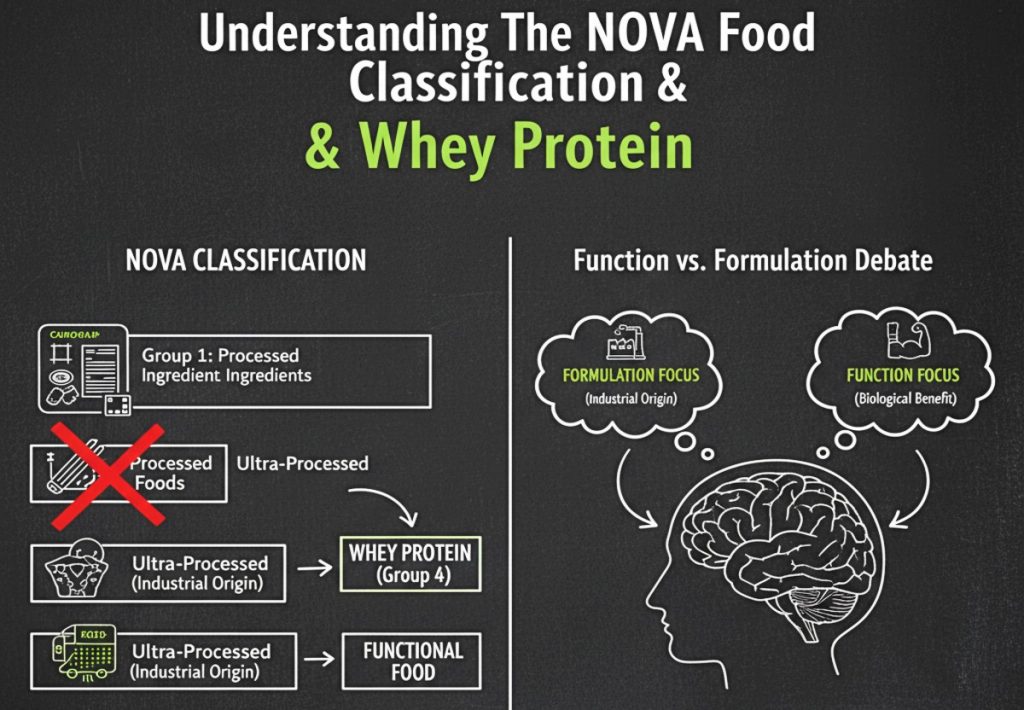
What Does “Ultra-Processed” Really Mean?
The term “ultra-processed food” (UPF) has become a hot topic in nutrition. A recent comprehensive database showing the prevalence of ultra-processing found that a staggering 73% of the U.S. food supply is ultra-processed. These items are often cheaper than minimally processed options but are significantly limited in terms of real nutrition.
Ultra-processed foods are typically “industrial formulations” made from oils, starches, sugar, and flavor enhancers. This is similar to how certain essential nutrients are often misunderstood when they are stripped from their natural context. Salt, for example, is essential to human physiology, yet it becomes problematic mainly because of its heavy presence in these industrial systems.
As explained in Is Salt Actually Bad for You? The Truth About Sodium and Health, the core issue is often not the ingredient itself, but how industrial food systems concentrate and overuse it within ultra-processed matrices. Understanding this distinction helps us evaluate whether the manufacturing of protein powders falls into the same category of concern.
The Verdict: Is Whey Protein an Ultra-Processed Food?
Yes—but context matters. Technically, whey protein is an industrial isolate, which places it in the UPF category. However, unlike sugary snacks or ready-to-eat meals, whey is a functional food.
- Purpose: It is designed to deliver amino acids efficiently.
- Nutritional Density: High-quality whey provides essential leucine for muscle protein synthesis.
- The Nuance: The problem isn’t the processing itself, but the additives like artificial dyes and thickeners found in lower-end brands.
The “Function over Formulation” Debate
Functional nutrition specialists often critique the NOVA system for being too rigid. A whey protein with 3 ingredients is technically a UPF, yet it is metabolically superior to many “natural” fruit juices that are loaded with liquid fructose.
How to Choose High-Quality Whey Protein
To ensure your supplement remains a healthy tool, you must know how to filter the noise. Since we established that is whey protein an ultra-processed food by definition, your goal is to find the least adulterated version.
- Check for Gums: Avoid excessive xanthan or guar gum if you have a sensitive gut.
- Avoid Artificial Dyes: Pure protein doesn’t need to be neon pink.
- Sweetener Quality: Opt for stevia or monk fruit over sucralose when possible.
Integration with Whole Foods
Even the best supplement cannot replace a whole-food diet. As Robert discussed in our guide on how to season steak with garlic overnight, the timing and quality of your whole-food proteins are just as important as your supplement choice.
Benefits of Whey Despite Its Classification
Even if is whey protein an ultra-processed food, its benefits for specific goals are well-documented in clinical research:
- Muscle Growth: Rich in all nine essential amino acids.
- Satiety: Helps regulate hunger hormones during weight loss.
- Quick Digestion: Ideal for post-workout recovery.
Risks and Considerations
While whey is generally safe and highly effective for most, some cautions apply to ensure it remains a beneficial part of your routine. The goal is to use it as a precision tool, not a dietary crutch.
- Additives: Some powders are loaded with stabilizers that may affect gut microbiome balance.
- Balance: Whole foods provide complex fiber and micronutrients that powders cannot replicate.
- Scientific Evidence: A recent study published in the National Institutes of Health (PMC) found that while protein-enriched ultra-processed foods can positively affect energy balance, overconsumption can still occur if not monitored. This highlights the need for mindful use—treating whey as a supplement rather than a free pass for unlimited calories.
FAQ – Whey Protein Edition
Is whey protein an ultra-processed food that is bad for you?
Technically, yes, it falls under the ultra-processed category due to the industrial isolation of the protein. However, unlike “junk” UPFs, high-quality whey is a functional food designed for nutrition. The key is to choose options with minimal additives to ensure your health remains the priority.
Can I replace meals with protein shakes?
No. While we’ve established the context of why is whey protein an ultra-processed food, it still lacks the fiber and micronutrient complexity of whole foods. Shakes should supplement your intake, not displace the variety of a balanced diet.
Are plant-based powders as effective as whey?
They can be, though absorption and amino acid profiles (like leucine levels) differ. Many plant-based options are also technically ultra-processed, so the same rules of checking for clean ingredients apply.
How much protein do I really need?
Most adults need ~0.8g per kg of body weight, while active individuals may need 1.2–2.0g. Using a supplement can help you reach these goals efficiently, provided you understand the quality of the product you are consuming.
Conclusion So, is whey protein an ultra-processed food? Yes, by technical definition, but its metabolic impact is vastly different from traditional UPFs. By choosing powders with minimal additives and focusing on “clean” processing, you can safely use whey as a powerful supplement in your nutritional toolkit.
Medical Disclaimer: The information provided on The NutriDeep is for educational and informational purposes only and is not intended as medical advice. While we strive to provide evidence-based content, nutrition science is a constantly evolving field. Always seek the advice of a qualified physician or healthcare provider with any questions you may have regarding a medical condition, diet, or supplement. Never disregard professional medical advice or delay in seeking it because of something you have read on this website.
