If you want to understand why you should never wash raw chicken, you are not alone. If you grew up watching your parents rinse poultry in the kitchen sink, the ‘don’t wash’ rule might sound wrong—almost unhygienic. But while it feels like you are cleaning the meat, science proves that washing raw poultry is actually one of the riskiest things you can do in your kitchen.
But once you actually look at the physics of what’s happening in your sink, your perspective shifts fast. The truth is that learning why you should never wash raw chicken is one of the most important safety steps you can take. It’s not that the water doesn’t wash some bacteria off; it’s that it turns your sink into a bacterial sprinkler system.
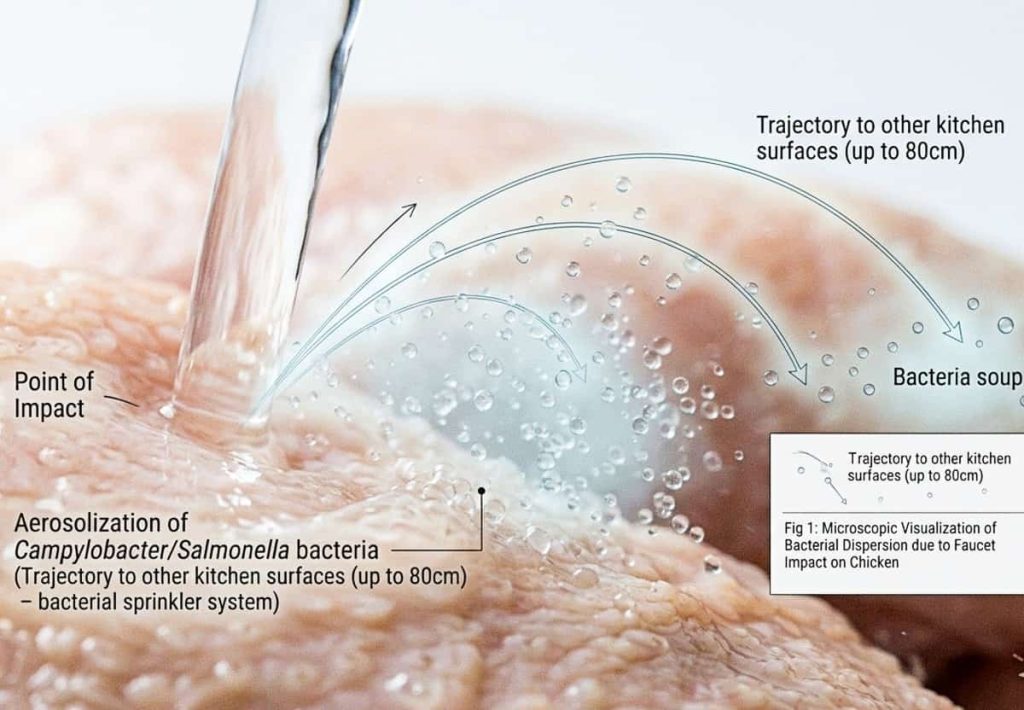
The Physics of the “Germ Spray”
When you wash chicken under a running tap, you aren’t just rinsing it. Because chicken meat is soft, the force of the water creates a small depression—a “divot”—on the surface. Instead of flowing smoothly, the water hits this divot and bounces back, creating a fine mist of contaminated droplets.
When scientists study why you should never wash raw chicken, they focus on the ‘splash-back’ effect. The force of the water against the protein fibers doesn’t clean the meat; it simply creates an invisible highway for pathogens to travel from your sink to your countertops.
The 80cm Bacterial Radius
Research from food safety agencies shows that this bacterial spray can travel up to 80 cm (about 31 inches) from your sink. That’s enough to land on your drying dishes, your fruit bowl, or the cutting board you’re about to use for a salad. This aerosolization is the primary reason why you should never wash raw chicken.
The “Sanitized Sink” Fallacy
Even if you try to “sanitize” the sink afterward, studies have found that 14% of people still had bacteria in their sinks even after they thought they had cleaned them. The goal of the “never wash” rule is to prevent the mess from becoming airborne in the first place.
The Cultural Conflict: Why “Just Don’t Do It” Isn’t Enough
For many, the advice to stop washing chicken feels like an attack on culinary heritage. In many regions, especially where poultry is bought fresh from a butcher, washing is a practical necessity to remove blood or bone fragments.
Regardless of how you were taught to prep poultry, the biological reason why you should never wash raw chicken remains the same: heat is the only effective sterilizer, and water is the primary carrier for cross-contamination.
Industrial vs. Agriculture-Direct Poultry
There is a massive gap between industrial Western poultry—which is pre-washed and processed—and agriculture-direct poultry found in other parts of the globe. Understanding this context helps bridge the gap between scientific safety and traditional practices.
Acidic Rinses: Vinegar and Lemon Juice
Many cooks wash chicken with lemon juice or vinegar to remove a “raw” smell. While this is a deep-seated tradition, microbiologists warn that acidic rinses don’t actually kill Salmonella or Campylobacter. They might change the smell, but the bacterial risk remains—and the splashing still happens.
Even if you use lemon or vinegar, it doesn’t change the fundamental fact of why you should never wash raw chicken. These liquids may alter the surface pH, but they do nothing to stop the physical spread of bacteria through splashing.
Poultry Safety Comparison: Methods and Risks
| Method | Effect on Bacteria | Cross-Contamination Risk | Recommendation |
| Running Water | Minimal removal | Extremely High (80cm spray) | Never |
| Vinegar/Lemon | Does not kill pathogens | High (via splashing) | Not Recommended |
| Paper Towel Pat | Removes moisture/slime | Low (if towel is discarded) | Safe Alternative |
| Cooking to 165°F | Kills all bacteria | Zero | The Gold Standard |
How to Handle Chicken Like a Pro
If the “slime” or “juice” on the chicken bothers you, there is a better way. Skip the tap and follow these specialist steps:
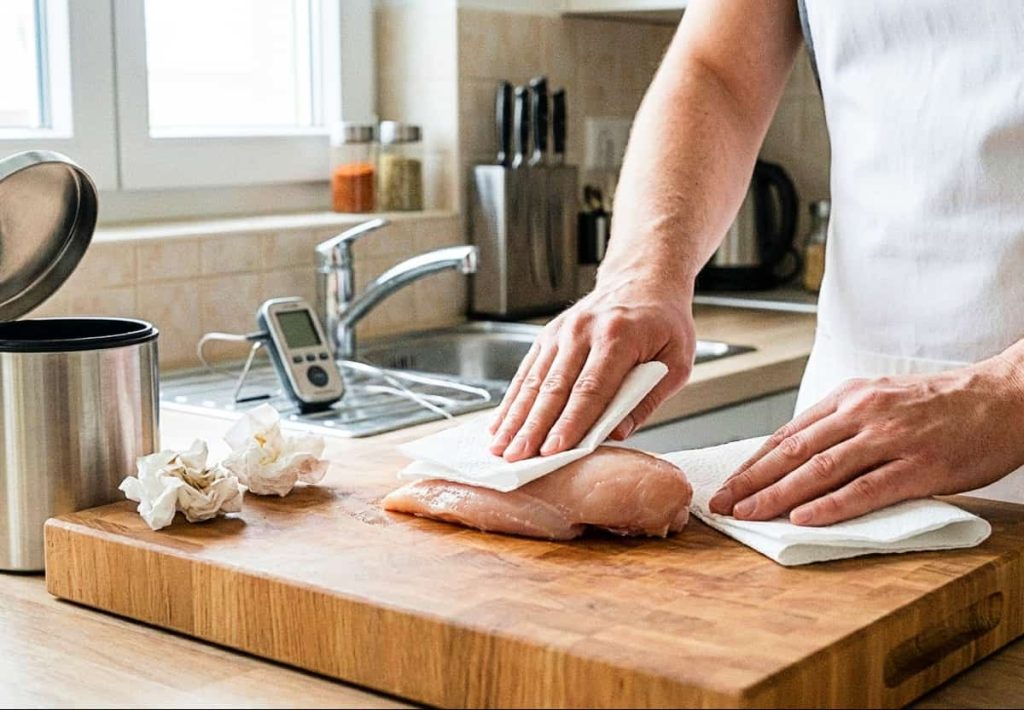
The “Pat and Toss” Technique
Use a clean paper towel to pat the chicken dry. This removes the “purge” (the pinkish liquid) without the splash. Toss the towel immediately and wash your hands.
The Cross-Contamination Sequence
Always chop your salad and vegetables before you even bring the chicken out of the fridge. This ensures your “ready-to-eat” foods are never in the path of potential poultry bacteria.
The 165°F Rule
Bacteria like Campylobacter are stubborn, but they can’t survive the heat. Use a meat thermometer to ensure the thickest part reaches 165°F (74°C). This is the only way to truly “clean” your meat.
Before we move to the common questions, remember that the core logic of why you should never wash raw chicken is to contain the bacteria to the meat itself, where the oven’s heat can safely destroy it.
FAQ: Your Chicken Safety Questions
1. Doesn’t the hot water from my tap kill the bacteria?
No. To kill Salmonella, water would need to be near boiling, which would scald your hands and start “cooking” the outside of the chicken without making it safe.
2. What if I wash it in a bowl of water instead of under the tap?
While this reduces the “mist,” you still have to deal with a bowl of “bacteria soup.” Discarding that water safely without splashing is nearly impossible in a standard kitchen.
3. Why is the liquid in the package pink?
That liquid is called “purge”—a mixture of water and protein (myoglobin). It is not blood, but it is highly contaminated with bacteria.
Final Thoughts on Kitchen Safety
At the end of the day, breaking a lifelong habit is hard. But once you realize that the heat of your oven is doing 100% of the cleaning, and the water in your sink is doing 100% of the contaminating, the choice of why you should never wash raw chicken becomes clear.
Ultimately, the choice is yours, but the data is clear on why you should never wash raw chicken. Prioritize your kitchen’s safety by keeping the faucet off and the thermometer on.
Disclaimer: This content is for educational purposes. For specific food safety guidelines in your region, consult your local health department or the USDA.
