Many athletes often ask: Can you take creatine with soda? While it seems like a convenient way to get your daily supplement dose, there are several scientific factors—ranging from carbonation physics to pH levels—that you need to consider before mixing your scoop.
In the world of fitness, few supplements are as legendary as Creatine Monohydrate. It’s the gold standard for power, recovery, and muscle saturation. But while the science of what it does is clear, the debate over how to drink it continues to bubble up.
If you’ve ever wondered if your favorite soda can be the ultimate “shuttle” for your daily 5g dose—or if the acidity will turn your supplement into waste—you aren’t alone. As explored in this detailed guide on creatine stability, the liquid you choose can either enhance your gains or create a “creatine volcano” in your shaker.
Medical Disclaimer: The content on The Nutrideep is for informational and educational purposes only. It is not intended to be a substitute for professional medical advice, diagnosis, or treatment. Always seek the advice of your physician or other qualified health provider with any questions regarding a medical condition or dietary changes.
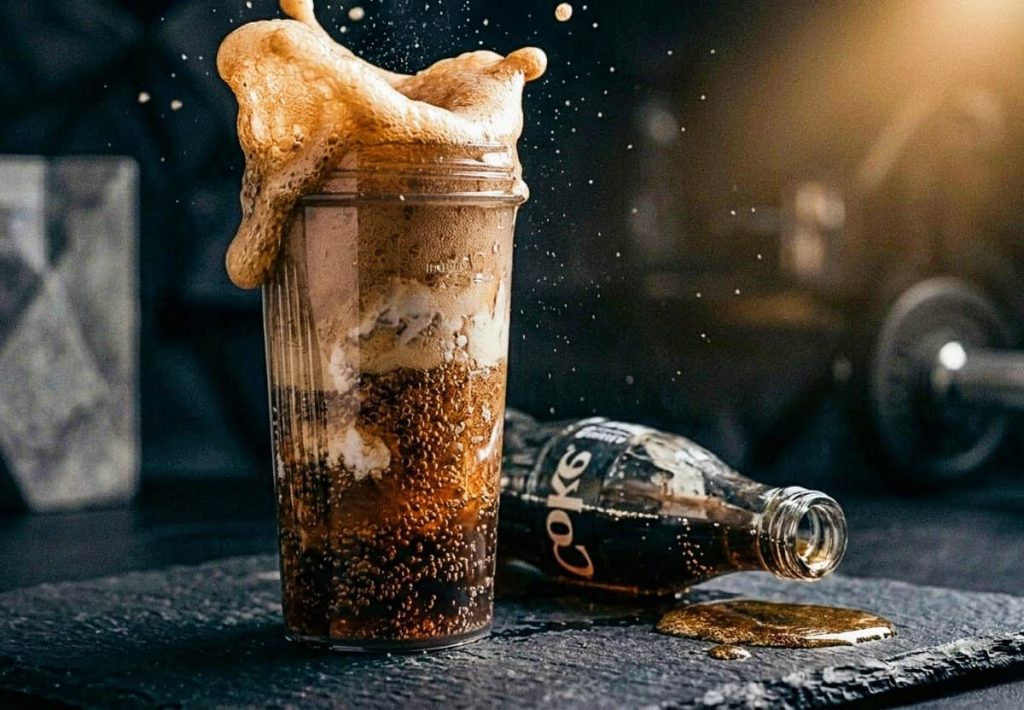
1. The “Mentos Effect”: A Physical Warning
Before we talk about biology, we have to talk about physics. Mixing fine creatine powder with a freshly opened carbonated drink can trigger a vigorous foaming reaction.
The Nucleation Trap
The tiny particles of creatine act as “nucleation sites,” causing the dissolved $CO_2$ in the soda to release all at once.
The Consequence
If you drop a scoop into a narrow bottle of Coke Zero or Pepsi, be prepared for a mess. You risk losing half your dose to the foam, which is—as any lifter knows—a cardinal sin of supplementation.
The Fix
Pour the soda into a wide glass, stir it gently to release excess gas, and then add your powder. Never mix it in a sealed shaker bottle.
2. The Chemical Clock: Acidity vs. Stability
Creatine is remarkably stable as a dry powder, but its “half-life” changes the moment it hits a liquid.
The Acid Factor
Most sodas are highly acidic (low pH). In an acidic environment, creatine begins a process called intramolecular cyclization, converting into creatinine—a metabolic waste product that offers zero performance benefits.
The Temperature Danger
This breakdown is accelerated by heat. While warm water helps solubility, mixing creatine with a “room-temp” acidic soda and letting it sit is a recipe for degradation.
The Rule
If you are determined to use a carbonated base, you must drink it immediately. The acidity of creatine with soda acts as a catalyst for degradation. Because the low pH of most sodas can accelerate the conversion to creatinine, a 30-minute delay could mean you’re flushing your gains down the drain. Always prioritize fresh, chilled mixtures to keep the creatine with soda ratio chemically stable until the moment you consume it.
3. The “Insulin Advantage” (The Non-Diet Pro)
There is actually a functional “pro” to using regular (non-diet) soda.
The Insulin Spike
High-sugar beverages trigger a significant release of insulin.
The Transport Mechanism
Insulin acts as a molecular “key” that opens the sodium-dependent transporters in your muscle cells. This helps “drive” the creatine into your muscles more efficiently than plain water could.
The Post-Workout Window
This is why many athletes prefer a sugary “shuttle” right after training when muscle sensitivity is at its peak.
4. The Dehydration Loop: Sodium & Caffeine
Creatine is an osmolyte—it works by drawing water into your muscle cells to keep them hydrated and volumized. Soda can complicate this.
The Dual Threat
- Caffeine Conflict: Many sodas contain caffeine, which is a mild diuretic.
- The “Water Tax”: If the soda helps flush water out while the creatine is trying to pull it in, you may experience headaches or cramping.
Because the act of taking creatine with soda involves both a supplement and a potential diuretic (caffeine), tracking your total fluid intake is non-negotiable. If you find that your stomach feels heavy after drinking creatine with soda, it is likely the combination of the carbonation and the increased osmotic pressure in your gut, rather than the creatine itself.
The Fix
If you choose soda as your base, you must “pay the water tax.” Drink an extra 8–12 oz of pure water shortly after to ensure your muscles have the fluid they need to store that creatine.
The “Traffic Light” Guide for Creatine Liquids
| Drink | Rating | Why? |
| Fruit Juice | 🟢 Excellent | Low acidity + high natural sugar. |
| Warm Water | 🟢 Best | Maximum solubility and stability. |
| Regular Soda | 🟡 Good | Great insulin response, but requires speed. |
| Diet Soda | 🔴 Poor | Acidic, no insulin benefit. |
FAQ: Everything You Need to Know About Creatine and Soda
1. Does taking creatine with soda cancel out the effects?
It doesn’t “cancel” them, but it starts a chemical countdown. The high acidity of the carbonated drink begins converting active creatine into creatinine. While the occasional intake of creatine with soda is unlikely to ruin your progress, it is not the most efficient delivery method compared to water or juice. If you enjoy the taste, minimize the exposure time between the powder and the liquid to maintain the integrity of your supplement.
2. Does the carbonation interfere with muscle absorption?
The gas ($CO_2$) doesn’t change the biology of how your muscles take in the powder. However, it can cause bloating. Stir the soda first to release the fizz.
3. Can I mix creatine with Diet sodas?
You can, but you lose the main technical advantage: the insulin spike that helps “shuttle” the creatine into your muscle cells.
The Bottom Line
You can take creatine with soda, but it isn’t the most stable environment for the powder. If you enjoy the flavor, stick to non-diet versions for the insulin benefit, mix it in a wide glass to avoid a “volcano,” and drink it instantly.
Ultimately, the most important factor isn’t the liquid—it’s consistency. Saturating your muscles takes time and daily discipline. To ensure you are maximizing your results, read our guide on 5 Powerful rules for creatine saturation: Why consistency trumps loading.
