If you want to understand what is diaas score and why it is triggering an absolute paradigm shift in nutrition science, you need to look past the single, deceptive number on the back of your food packaging: “Protein: 20g.” For decades, we have trusted this metric to build lean muscle, recover from intensive surgeries, or maintain skeletal health as we age.
However, the uncomfortable biochemical truth is that this number is, at best, a lazy administrative estimate and, at worst, a complete physiological fabrication. The old food measurement system is officially being exposed as deeply flawed, and a new academic framework is revealing that what you swallow is rarely what your cells actually receive.
The Problem: The Industrial Blind Spots of PDCAAS
Since 1991, the global food manufacturing industry has relied blindly on a system called PDCAAS (Protein Digestibility-Corrected Amino Acid Score). While it sounds highly technical on paper, metabolic researchers are increasingly calling out its two fatal flaws:
The Flawed Rat Model
The entire PDCAAS database is calculated based on the digestive tract efficiency of growing rats. Humans are fundamentally not rodents. Our metabolic pathways and intestinal walls process proteins completely differently, especially when forced to deal with complex plant-based fibers, phytates, and dense anti-nutrients.
The Fecal Evaluation Lie
PDCAAS measures the amount of nitrogen and protein left over in the animal’s feces. The biological problem? The dense colonies of bacteria living in your large intestine (colon) readily consume and ferment the protein that your body completely failed to absorb in the upper tract. This process makes it look like your muscles utilized the nutrients, when in reality, it was just expensive food for your gut flora.
The Solution: Explaining What Is DIAAS Score
The revolution arrived when the Food and Agriculture Organization (FAO) introduced the DIAAS (Digestible Indispensable Amino Acid Score) model.
Small Intestine Absorption Metrics
DIAAS completely changes the metabolic game by measuring amino acid absorption precisely at the very end of the small intestine, known as the ileum. This shift is vital: if a specific amino acid has not crossed the intestinal wall by the time it reaches the ileum, it is effectively lost to your skeletal muscles, organs, and systemic recovery pathways.
“DIAAS is the first method to treat amino acids as individual nutrients—like Vitamin C or Iron—rather than just a generic mass of ‘protein’.” > — Dr. Paul Moughan, Riddet Institute.
The Truth Table: A Physiological Reality Check
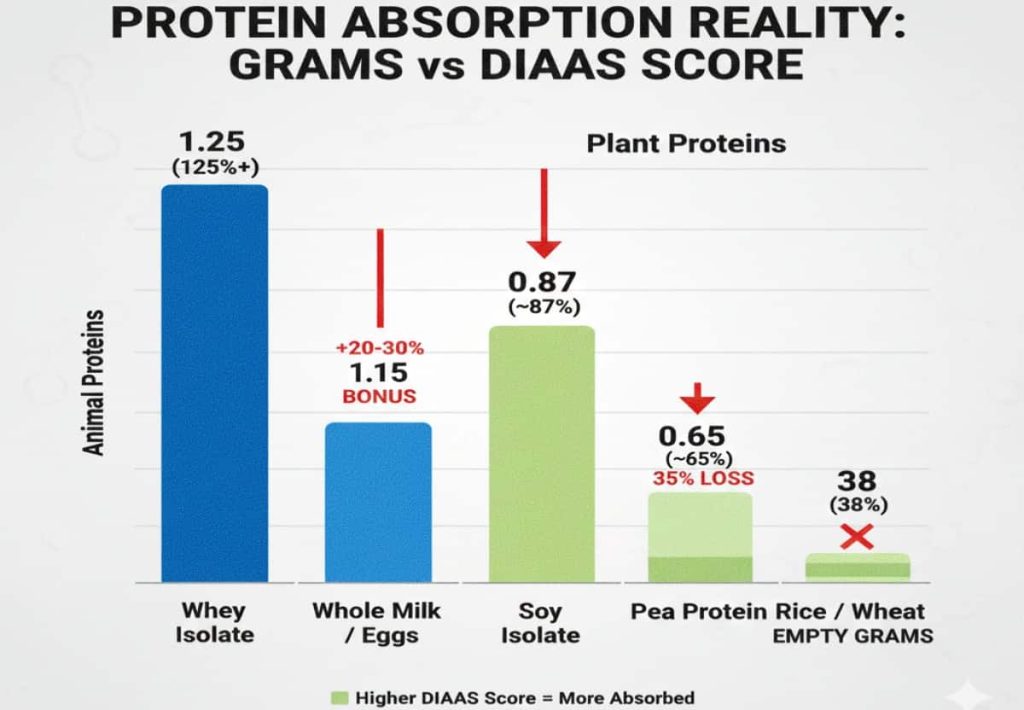
When we stop using outdated food math and apply the real-world metrics of what is diaas score, the actual ranking of everyday protein sources shifts dramatically. The old artificial “cap” of 100% ($1.0$) is completely removed, finally allowing high-tier, highly bioavailable proteins to demonstrate their true physiological dominance.
| Protein Source | Old Score (PDCAAS) | Real Score (DIAAS) | The “Absorption Tax” Impact |
| Whey Protein Isolate | 1.0 (Capped) | 1.09 – 1.30 | +25% Metabolic Bonus |
| Whole Milk / Eggs | 1.0 | 1.13 – 1.18 | Maximum Cellular Efficiency |
| Soy Isolate | 0.91 – 1.0 | 0.84 – 0.90 | ~10% Hidden Net Loss |
| Pea Protein | 0.83 | 0.64 – 0.66 | Critical 20% Structural Loss |
| Rice / Wheat | 0.45 – 0.50 | 0.37 – 0.40 | Essentially “Empty” Grams |
Note: While DIAAS proves that animal proteins are technically superior in isolation, the amino acid profiles of plant-based sources can be significantly optimized through strategic protein-pairing. The core challenge isn’t the plant protein itself, but our systemic insistence on measuring plant-based efficacy as if it were physiologically identical to animal-based structures.
Industry Friction: Why Hasn’t Your Food Label Changed Yet?
The global corporate food industry is currently in a massive state of friction regarding these updates. If a transition occurs and the newer score becomes the mandatory legal labeling framework worldwide, the market will face severe shakeups.
Loss of Legal Marketing Claims
Many heavily processed “Plant-Based” or vegan alternative products would instantly lose the legal right to feature a “High in Protein” badge on their front-facing boxes.
Exposure of Real Consumer Cost
The actual financial cost per absorbed gram of clean protein would make specific synthetic alternatives look exponentially more expensive than traditional dairy, eggs, or meat.
The High Financial Testing Barrier
While the methodology is scientifically indisputable, executing ileal testing is incredibly expensive and complex. Smaller, ethical health brands argue that mandating this system creates an unfair market barrier to entry, while dairy and livestock advocates argue that consumers have a baseline right to know if they are receiving 30% less nutrition than advertised.
Application: Protecting Your Nutrient Intake from Thermal Damage
Understanding how your body absorbs amino acids is only one part of the nutritional health puzzle. To ensure that the clean, high-tier proteins you are buying are actually making it to your muscle tissues, you must be careful with how you prepare them at home.
Subjecting delicate proteins to excessive, direct heat (such as heavy charring or burning) causes severe chemical Maillard damage. This reaction structurally deforms and destroys vital, sensitive amino acids like Lysine. If you compromise the molecular integrity of your food on the stove, your digestive enzymes won’t be able to process those amino acids, causing your real-world absorption rate to plummet, regardless of what the label promises. Protecting your biological intake requires precise control over your daily food preparation.
FAQ: Navigating Protein Quality and Absorption Metrics
If I prefer plant-based diets, is my protein shake a waste of time? Not at all, but you must factor in what researchers call the “protein tax.” When navigating what is diaas score parameters, plant isolates require you to consume roughly 20% to 30% more total volume in grams to trigger the exact same muscle protein synthesis (MPS) pathways as whey or whole egg matrices.
When looking at what is diaas score metrics, why does a high-quality whey protein isolate score over 100%? The older system artificially capped all scores at a maximum of 1.0 (100%). Because DIAAS is completely uncapped, a score of 1.25 means the source delivers a vast surplus of essential amino acids. These extra blocks can help “subsidize” and balance out lower-quality, incomplete proteins consumed later in your daily diet.
Can I manually fix a low vegetable protein score? Absolutely. This is the foundational “secret sauce” of culinary biology. By combining a food that is naturally low in the amino acid Lysine but high in Methionine (such as brown rice) with a food that is high in Lysine but low in Methionine (such as black beans), you create a complete, high-functioning amino acid matrix that mimics high-tier biological scores.
When will global food labels change to reflect what is diaas score data? It’s a slow battle. Regulatory bodies are hesitant to force a change because DIAAS is more expensive and complex to test than the old rat-based PDCAAS. For now, the “Protein Tax” remains a secret between you and your small intestine.
Curator’s Note on Scientific Sources: This nutritional blueprint was compiled by synthesizing data from the FAO Expert Consultation on Protein Quality Evaluation and the latest 2024 retrospective reviews led by Prof. Paul Moughan and Wen Xin Janice Lim. At Nutrideep, Emma and our research team believe in radical transparency: we curate verified metabolic realities over corporate food marketing.
