Have you ever wondered why some coffee tastes like a masterpiece while others feel like a chore to drink? Most people think they need a $2,000 espresso machine or a barista certification to make a great cup. However, the secret isn’t in the equipment—it’s in the math.
By applying the 80/20 rule in coffee, you can stop obsessing over minor details and focus on the few variables that actually dictate the quality of your brew. If you want to simplify your morning routine, mastering the 80/20 rule in coffee is the ultimate shortcut.
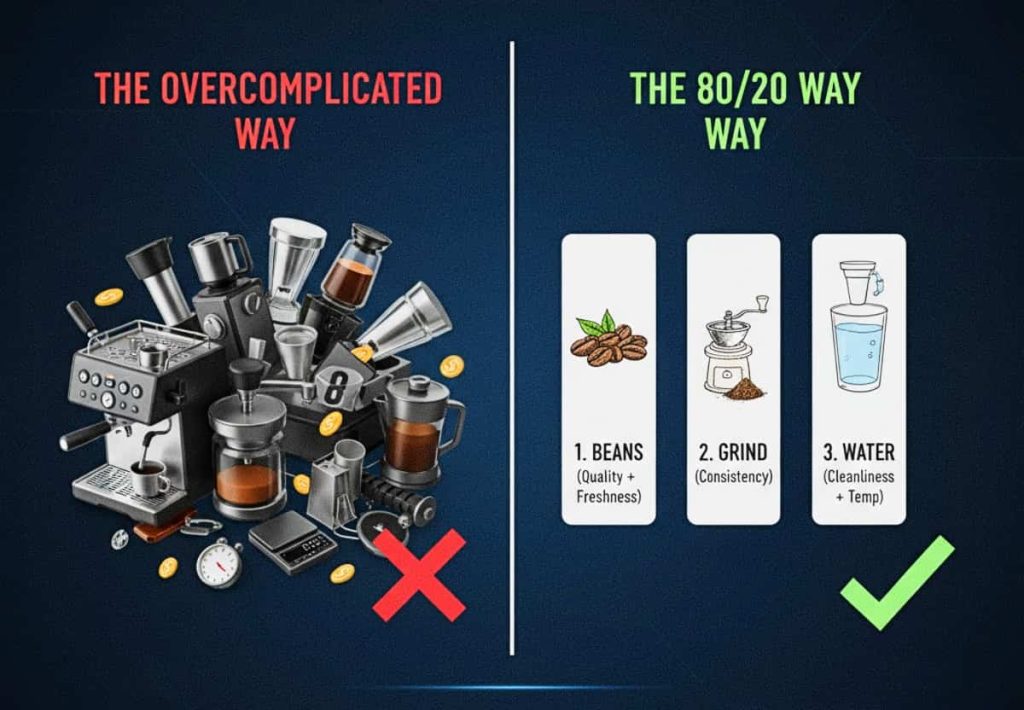
📱 Visual Guide: Tap to see the 80/20 Coffee Fundamentals.
What is the 80/20 Rule in Coffee?
The 80/20 Rule, also known as the Pareto Principle, suggests that 80% of your results come from just 20% of your efforts. In the world of caffeine, this means that out of the dozens of variables involved—altitude, soil chemistry, pressure, humidity, and flow rate—only a handful truly determine if your coffee tastes good or bitter.
Instead of getting lost in the “noise” of specialty coffee culture, the 80/20 rule in coffee forces you to identify the “vital few” elements that transform a muddy cup into a vibrant experience. While adhering to these core principles simplifies your routine, specialists often point out a persistent nuance in the community: some advanced practitioners debate whether this simplified approach is truly sufficient for connoisseurs seeking the absolute pinnacle of taste. Specifically, purists argue that chasing that final tier of perfection—often called the “god shot”—demands an exponentially higher investment of precision and advanced techniques, meaning the line between simplicity and obsession can sometimes blur depending on your ultimate standards.
By consciously adopting the 80/20 rule in coffee, home enthusiasts discover that everyday brewing becomes far less intimidating and vastly more sustainable. While purists might argue about microscopic extraction yields, the reality of the 80/20 rule in coffee is that it liberates you from unnecessary kitchen anxiety. Experts often debate where the exact boundary lies between a good cup and a transcendent one, but field tests consistently show that obsessing over the final 2% of variables yields diminishing returns. Ultimately, mastering the 80/20 rule in coffee unlocks pure efficiency, allowing you to focus on sensory enjoyment rather than laboratory-grade measurements.
For those looking to optimize other aspects of their morning regimen, pairing your brew with the right fuel is equally important, such as exploring Best high-protein breakfast: 24g to stabilize blood sugar to maintain consistent metabolic energy throughout the day.
The 20% That Creates 80% of the Flavor
To get the most out of your beans, you need to focus on three main pillars. These are the elements where 20% of your attention will yield the biggest return on investment.
Embracing this targeted philosophy within the 80/20 rule in coffee protects you from clever marketing traps designed to sell redundant accessories. When you filter out the commercial noise, your energy and resources are channeled directly through the 80/20 rule in coffee into variables that radically shift flavor profiles. Critics sometimes point out that individual palate sensitivity varies, meaning what works for one taster might need slight tweaking for another. Yet, the foundational mechanics of the 80/20 rule in coffee remain robust across different roast profiles and brewing devices, safeguarding both your budget and your daily schedule.
1. Bean Quality and Freshness
Choosing high-quality beans is the core of the 80/20 rule in coffee, as it impacts the majority of the final taste. If the beans are stale or poorly roasted, no amount of technique can save the brew.
Prioritizing agricultural excellence when applying the 80/20 rule in coffee guarantees that natural aromatic complexities shine through, further cementing why the 80/20 rule in coffee neutralizes the need for artificial additives or heavy sweeteners to mask defects.
Coffee researchers frequently debate whether origin terroir outweighs roast precision, but there is widespread consensus that stale beans neutralize any technical mastery. Further cementing why the 80/20 rule in coffee neutralizes the need for artificial additives, fresh sourcing preserves delicate fruit acids and lipid structures. Consequently, respecting the bean’s origin forms the bedrock of the 80/20 rule in coffee, proving that no filter or kettle can ever resurrect dead, oxidized coffee beans.
Why Roast Date Matters
Coffee is a fresh agricultural product. Once roasted, it begins to lose its aromatic oils. For the best 80/20 results, buy coffee with a “roasted on” date within the last 2-4 weeks.
Respecting this critical window of peak degassing ensures that the 80/20 rule in coffee delivers optimal crema, vibrant acidity, and a balanced body that older supermarket packages simply cannot replicate. While some specialty roasters advocate for resting beans up to a month depending on the processing method, everyday brewing proves that the initial weeks offer the most forgiving extraction window. Validating the 80/20 rule in coffee for daily use means recognizing that carbon dioxide release directly dictates flow rate stability, making fresh roast dates a non-negotiable priority for anyone seeking maximum flavor with minimal friction.
2. The Golden Ratio: Water to Coffee
The most common mistake is simply “eyeballing” the amount of coffee. Using a simple 1:16 ratio (1 gram of coffee for every 16 grams of water) is the 20% effort that fixes 80% of brewing errors.
Eliminating guesswork through precision weighing anchors the 80/20 rule in coffee, providing a repeatable baseline that eliminates batch-to-batch inconsistency. Some traditional baristas rely on volumetric scoops, arguing that kitchen scales complicate a relaxed morning ritual, but data-driven brewers know that mass ratios prevent underextraction. As you implement the 80/20 rule in coffee across different origins and processing methods, sticking to a fixed ratio ensures that your flavor adjustments remain isolated solely to grind size and water temperature, cutting troubleshooting time in half.
Mastering Extraction Without the Stress
Understanding extraction doesn’t have to be a technical nightmare. If you focus on the contact time between water and coffee, you’ve already solved most of the problem.
Efficiency in Brewing Tools
For those seeking practicality without sacrificing flavor, specific tools apply Pareto’s principle perfectly. A practical example is the BRUW Cold Brew Filter (as seen on Shark Tank), which simplifies the filtration process by focusing on what truly matters: separating the grounds from the concentrate cleanly and quickly.
Leveraging smart design innovations reinforces the 80/20 rule in coffee by cutting down tedious cleanup time and mechanical friction. While minimalist purists claim that immersion brewers or complex drippers are the only path forward, automated and streamlined tools bridge the gap between speed and quality. Making daily specialty brewing an effortless habit supported by the 80/20 rule in coffee rather than an exhausting chore ensures consistency over the long term, because a routine you actually enjoy executing is always superior to an overly complicated ritual you abandon after three days.
The 80/20 Method by Barista Hustle
If you want to dive deeper into extraction science without getting lost in complex calculations, the 80/20 method by Barista Hustle is the gold standard reference. It teaches that instead of trying to fix every tiny detail of a bad extraction, you should focus on adjusting grind size and water quality first. According to this approach, these two factors alone correct the vast majority of bitter or sour flavor issues.
Translating this methodology into everyday practice proves that mastering the 80/20 rule in coffee relies on targeting foundational levers rather than chasing phantom variables like water pressure profiling or ultra-specific mineral balancing. Although advanced coffee science journals love exploring minor ionic interactions, home practitioners benefit most by keeping variables constrained. Securing the true value of the 80/20 rule in coffee for flavor improvement means trusting that fixing your grind distribution and thermal stability resolves almost every major cup defect you will ever encounter.
Although advanced coffee science journals love exploring minor ionic interactions, home practitioners benefit most by keeping variables constrained. Securing the true value of the 80/20 rule in coffee for flavor improvement means trusting that fixing your grind distribution and thermal stability resolves almost every major cup defect you will ever encounter in your home kitchen.
Common Pitfalls: The 80% of Effort That Yields Little Result
Many beginners overcomplicate things, but the 80/20 rule in coffee proves that focus is more important than expensive gear. Spending hours researching the “perfect” gooseneck kettle usually falls into the 80% of effort that only improves flavor by a negligible margin.
Recognizing these marketing-driven distractions protects your budget, ensuring that your application of the 80/20 rule in coffee remains grounded in practical efficiency and genuine taste enhancement through the 80/20 rule in coffee.
Many enthusiasts fall into the trap of upgrading equipment before refining their sensory evaluation skills, mistakenly believing that hardware compensates for fundamental technique. Ensuring that your application of the 80/20 rule in coffee remains grounded in practical efficiency and genuine taste enhancement through the 80/20 rule in coffee keeps your focus sharp, proving that human palate awareness is always a better investment than a more expensive accessory.
The Specialist’s Nuance: Complexity vs. Simplicity
Experts often debate whether the 80/20 rule in coffee is enough for true aficionados. While the 20% effort (grind size, water temp, and bean quality) gets you an amazing cup, some professional baristas argue that the remaining 20% of flavor—the “god shot”—requires 80% more precision. For the daily home brewer, the nuance lies in knowing when to stop; Pareto’s principle is the most efficient way to avoid “coffee fatigue.”
Navigating this ongoing industry debate highlights that while purists thrive on micro-adjustments, the 80/20 rule in coffee remains the ultimate tool for achieving high satisfaction, proving that the 80/20 rule in coffee avoids perfectionist burnout.
Some competition-level baristas argue that ignoring the finer 20% of nuances disrespects the farmer’s labor, but everyday consumers operate under different constraints of time and energy. Proving that the 80/20 rule in coffee avoids perfectionist burnout, this balanced approach allows you to appreciate world-class flavor profiles while maintaining a peaceful, stress-free morning routine that respects both your schedule and your mental well-being.
How to Apply the Pareto Principle to Your Morning Routine
Applying the 80/20 rule in coffee allows you to enjoy specialty-grade flavor without becoming a full-time barista. Focus on these three steps:
- Invest in a Burr Grinder: Consistency is key.
- Filter Your Water: Coffee is 98% water.
- Watch the Temperature: Aim for 195°F to 205°F.
Integrating these high-impact routines into your daily schedule secures the maximum flavor return on investment, transforming a chaotic kitchen counter into an efficient brewing station. While some morning schedules are tight enough to demand instant coffee, taking just three minutes to align your grinder and water temperature changes the entire trajectory of your morning.
Proving that the 80/20 rule in coffee is as much about lifestyle harmony as it is about exceptional taste unlocked via the 80/20 rule in coffee, this framework ensures that gourmet quality fits naturally into a busy modern lifestyle. To fine-tune your overall liquid and caffeine intake windows while keeping your metabolic rhythm optimized, consider exploring 2-Hour coffee rule: The simple science to master your caffeine timing for complementary daily habits.
FAQ: Mastering the 80/20 Rule in Coffee
Is expensive equipment part of the 20% that matters? Usually, no. A simple French Press with great beans beats a $2,000 machine with cheap beans.
What is the most important variable in the 80/20 rule? Grind consistency. If your grounds are uneven, the extraction will be unbalanced.
Addressing these common questions clarifies that smart prioritization under the 80/20 rule in coffee delivers superior outcomes, reassuring anyone relying on the 80/20 rule in coffee to refine their palate with minimal friction.
While exceptions always exist in artisanal crafts, the fundamental law of diminishing returns applies heavily to beverage preparation. Reassuring anyone relying on the 80/20 rule in coffee to refine their palate with minimal friction, this pragmatic philosophy demonstrates that excellence is achieved through deliberate focus, not by overcomplicating every single step of the extraction and preparation cycle.
Disclaimer: Caffeine sensitivity varies per person. Consult a health professional if you have heart or digestive conditions related to coffee consumption.
